
Subterranean Termites in Kuwait: Signs, Damage, and Professional Treatment
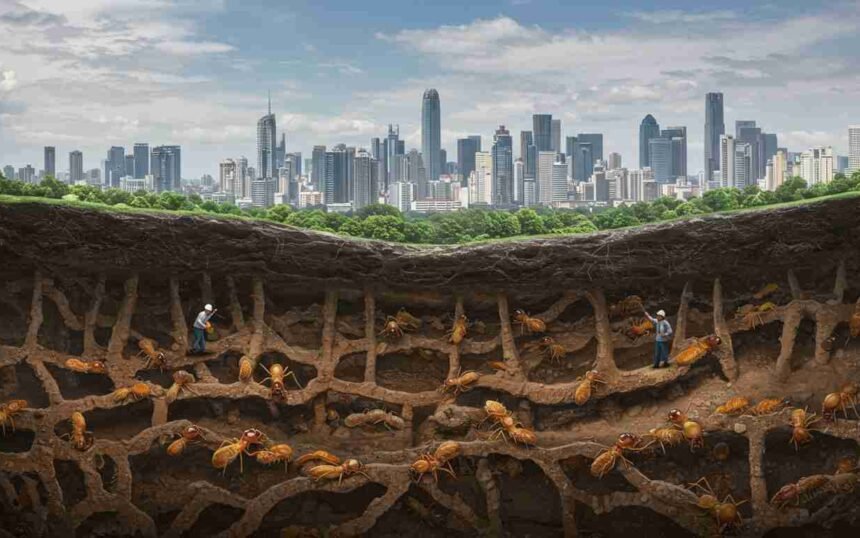
Beneath Kuwait’s modern skyline and manicured villa gardens, a hidden infrastructure of tunnels, chambers, and foraging networks stretches through the soil — built by subterranean termites. These insects are the single most destructive pest threat to property in the Arabian Gulf region, causing more structural damage annually than fires, floods, and earthquakes combined. Yet most property owners in Kuwait don’t think about termites until the damage is already done.
This article takes a deep dive into subterranean termites specifically in Kuwait’s context — how they behave in desert soil, what their damage really looks like, why standard detection methods often fail, and what professional treatment actually involves.
Understanding Subterranean Termites
Colony Structure
A subterranean termite colony is a highly organized superorganism with a rigid caste system:
| Caste | Role | Quantity | Lifespan |
|---|---|---|---|
| Queen | Egg production (up to 30,000/day in mature colonies) | 1 (sometimes multiple) | 15–25 years |
| King | Mating with queen | 1 | 15–25 years |
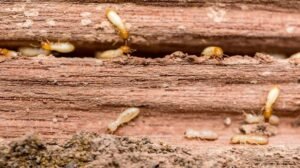
| Workers | Foraging, feeding the colony, building tunnels and nests | 80–90% of colony | 1–2 years |
| Soldiers | Colony defense against ants and other predators | 5–10% of colony | 1–2 years |
| Alates (reproductives) | Swarm, mate, and establish new colonies | Produced seasonally | Die after swarming (if they don’t found a colony) |
The workers are the caste that causes damage. They forage continuously, 24 hours a day, traveling through underground tunnels and mud tubes to reach cellulose-containing materials — primarily wood, but also paper, cardboard, and certain fabrics.
Foraging Behavior in Kuwait
Subterranean termites in Kuwait forage differently than their counterparts in more temperate climates:
- Deeper tunneling: In the extreme summer heat, termites tunnel deeper in the soil (30–100cm below surface) where moisture is retained, then move upward toward buildings through cracks and utility conduits
- Moisture dependency: They must maintain contact with soil moisture. In Kuwait’s dry surface soil, this means they are strongly attracted to irrigated areas, leaky pipes, and AC condensate drains
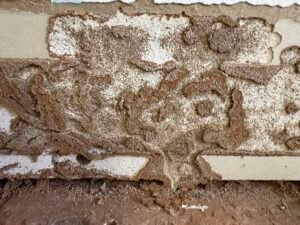
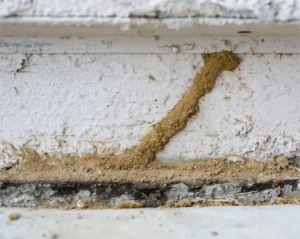
- Mud tube construction: Above-ground foraging is always protected by mud tubes — pencil-width shelter tubes made of soil, saliva, and fecal material. These are the most visible sign of subterranean termite activity
- Wide foraging range: A single colony’s foraging territory can extend 50–100 meters in any direction. Your neighbor’s termite problem is effectively your problem too
Swarming Season in Kuwait
Subterranean termites in Kuwait typically swarm in spring (March–May) and sometimes after rain events. During swarming:
- Hundreds to thousands of winged reproductives (alates) emerge from existing colonies
- They fly toward light sources — which is why they’re often found near windows and lights
- After a brief flight, they shed their wings and attempt to pair off
- Mated pairs seek moist soil to excavate a chamber and begin a new colony
- Only a tiny fraction successfully establish new colonies, but those that do grow rapidly
If you see winged termites or discarded wings inside your home, it means a mature colony is within foraging distance — and possibly already inside your structure.
How Subterranean Termites Enter Buildings in Kuwait
Primary Entry Points
Understanding how termites enter is essential for both prevention and treatment:
1. Foundation cracks and expansion joints
Even hairline cracks in concrete foundations provide sufficient access for termites. Expansion joints between floor slabs and walls are particularly vulnerable entry points, especially in Kuwait where thermal cycling causes repeated expansion and contraction.
2. Plumbing penetrations
The gaps around water supply lines, drain pipes, and sewer connections that pass through foundation slabs are among the most common termite entry points. These gaps are rarely sealed properly during construction in Kuwait.
3. Utility conduits
Electrical conduits, cable trays, and communication lines that pass through foundations create ready-made termite highways. Termites can travel through these conduits to reach upper floors.
4. Left-in-place formwork
A construction practice common in Kuwait involves leaving wooden formwork and shoring in place after concrete is poured. This wood is buried in or beneath the foundation slab, providing termites with a food source directly at the building’s most critical structural point.
5. Soil-to-wood contact
Where wooden elements — door frames, baseboards, siding — touch soil directly, termites can move from the soil into the wood without ever exposing themselves to open air. This is common in older Kuwaiti buildings where foundation clearance is insufficient.
6. Landscaping changes
New garden beds, irrigation systems, or soil grading changes that bring moist soil into contact with the foundation can create new termite entry points years after construction.
The Hidden Path: How Termites Travel Inside Walls
Once inside a building, termites don’t just eat the wood they entered through. They travel systematically through the structure:
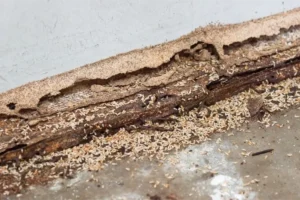
- They follow the grain of wood, creating galleries (hollowed-out channels) inside beams, studs, and joists
- They build shelter tubes across non-wood surfaces (concrete, drywall, metal) to reach new wood sources
- They exploit gaps between structural elements to move between floors
- They are attracted to moisture sources — leaky pipes, condensation, poor ventilation — and establish satellite colonies near these areas
All of this happens invisibly, behind walls, under floors, and above ceilings.
Recognizing Subterranean Termite Damage
Early Stage Damage (Months 1–6)
At this stage, damage is virtually invisible without specialized equipment:
- Internal wood galleries beginning to form inside structural members
- No external signs visible to the naked eye
- Only detectable through professional moisture readings or thermal imaging
- Termites may have consumed only a small percentage of a single beam
This is the ideal time for treatment — but rarely when it’s detected.
Moderate Damage (6 Months–3 Years)
More wood has been consumed, and some external signs may appear:
- Mud tubes on foundation walls, in utility closets, or along baseboards
- Slight softening of wood when tapped — though the surface still appears intact
- Discarded wings near windows after swarming events
- Minor warping of door and window frames due to moisture introduced by termites
- Stiff or stuck doors caused by frame distortion
At this stage, professional treatment can still prevent significant structural damage.
Severe Damage (3+ Years)
Structural integrity is compromised:
- Sagging or springy floors — floor joists have been substantially consumed
- Hollow-sounding wood — tapping with a screwdriver reveals extensive internal damage
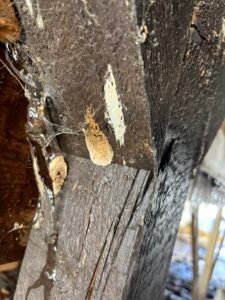
- Visible galleries — when damaged wood is cut open, the honeycomb-like internal damage is apparent
- Buckling walls or ceilings — structural members can no longer support their loads
- Mud tubes in multiple locations — indicating a large, well-established foraging network
- Difficulty closing doors and windows — frames significantly warped
At this stage, repair costs escalate dramatically because structural replacement is required, not just termite treatment.
How to Distinguish Termite Damage from Other Problems
| Feature | Termite Damage | Water Damage | Carpenter Ant Damage |
|---|---|---|---|
| Wood surface | Intact, appears normal | Discolored, swollen, soft | Small round openings visible |
| Internal appearance | Honeycomb galleries with mud | Soft, rotted, crumbly | Clean, smooth galleries |
| Presence of mud | Yes (in galleries and tubes) | No (water staining instead) | No |
| Frass/droppings | Mud-like material pushed out | None | Sawdust-like pellets |
| Associated moisture | Localized (near termite activity) | Widespread (follows water flow) | Minimal |
| Sound when tapped | Hollow, papery | Dull, soft | Hollow (less pronounced) |
Professional Treatment: What Actually Happens
Soil Treatment (The Standard Approach)
Soil treatment is the most common and effective method for subterranean termite control in Kuwait. Here’s exactly what the process involves:
Pre-treatment assessment:
- Full property inspection to identify entry points, damage extent, and foraging areas
- Determination of construction type (slab-on-grade, basement, crawl space) — affects treatment approach
- Identification of wells, water features, and environmental considerations
- Measurement of property perimeter and interior floor area for termiticide calculation
Application process:
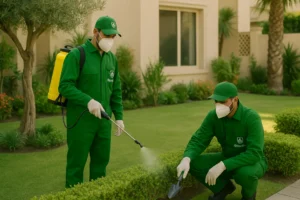
- Exterior perimeter treatment: Holes drilled at 30–45cm intervals along the foundation, through concrete walkways and patio slabs. Termiticide injected under pressure to saturate the soil adjacent to the foundation
- Interior treatment: Where termites are active inside, holes drilled through floor slabs at the wall-floor junction. Termiticide injected to create a barrier beneath and around the slab
- Plumbing and utility penetrations: Special attention to areas where pipes and conduits pass through the slab — termiticide injected around these critical entry points
- Expansion joints: Treated with termiticide to seal these common termite highways
- Drill hole sealing: All holes filled with matching concrete or epoxy
Post-treatment:
- Treatment report documenting all application details, product used, and concentration
- Follow-up inspection scheduled for 3 months post-treatment
- Annual inspection recommended to verify continued protection
Products commonly used in Kuwait:
- Fipronil-based termiticides (5–8 year residual)
- Imidacloprid-based termiticides (5–7 year residual)
- Chlorantraniliprole-based termiticides (7–10 year residual)
Bait System Treatment (The Colony Elimination Approach)
Bait systems take a fundamentally different approach — instead of creating a chemical barrier, they eliminate the colony entirely.
Installation:
- Bait stations placed in the ground at 3–5 meter intervals around the building perimeter
- Each station contains a wood monitoring block (initially) or active bait cartridge
- Stations are labeled and mapped for future reference
Monitoring phase:
- Technician visits every 2–3 months to check stations for termite activity
- When termites are found feeding on a monitoring block, it’s replaced with an active bait cartridge containing a slow-acting toxicant
- Termites feed on the bait and carry it back to the colony
Colony elimination:
- Over 2–6 months, the bait is distributed throughout the colony
- The slow-acting toxicant prevents molting (chitin synthesis inhibitors) — termites die during their next molt
- As workers die, the queen and nymphs starve
- The entire colony is eliminated
Long-term protection:
- After colony elimination, stations are returned to monitoring mode
- Regular inspections ensure any new colonies are detected early
- New bait is deployed immediately if activity is found
Combined Approach: Soil Treatment + Bait Systems
For maximum protection in Kuwait, many professionals recommend a combined approach:
- Soil treatment provides an immediate chemical barrier that stops termites from entering the building
- Bait systems provide ongoing colony elimination and monitoring, catching any termites that attempt to breach the soil barrier
This combined approach offers the fastest protection with the most comprehensive long-term security.
Special Considerations for Kuwait
Villa Gardens and Irrigation
Kuwait’s villa gardens create ideal conditions for subterranean termites. The combination of irrigation, wooden landscape elements, and proximity to the building foundation means that:
- Gardens should be included in any termite treatment plan
- Irrigation systems should be designed to avoid saturating soil near the foundation
- Wooden pergolas, fences, and planters should be constructed from treated wood or alternative materials
- Palm tree bases should be inspected regularly — they are natural termite habitats
New Construction Requirements
Kuwait Municipality requires termite pre-treatment for new construction in many areas. The requirements include:
- Soil treatment beneath and around the foundation before concrete pouring
- Treatment of all plumbing and utility penetrations
- Treatment documentation submitted to the municipality
- Post-construction verification inspection
Despite these requirements, enforcement is inconsistent. Property owners should verify that pre-treatment has been completed properly and documented.
Multi-Unit Buildings
In apartment buildings and commercial complexes, termite treatment requires building-wide coordination:
- Treating individual units is insufficient — termites travel between units through shared walls and utility chases
- Building management should coordinate annual inspections for all units
- Common areas (lobbies, parking structures, utility rooms) require regular monitoring
- Treatment of one unit can cause termites to move to adjacent untreated units
Frequently Asked Questions
Q: If my neighbor has termites, will my property be affected?
A: Very likely. A single subterranean termite colony can forage up to 100 meters from its center. If your neighbor’s property has an active colony, your property is within foraging range. Inform your termite control provider about nearby infestations so they can factor this into your inspection and treatment plan.
Q: Can termites damage concrete?
A: No, termites cannot eat concrete. However, they can exploit cracks as narrow as 1mm to pass through concrete slabs and walls. They can also damage the wooden formwork left inside concrete during construction. The concrete itself remains intact, but termites use it as a highway to reach wooden elements.
Q: How quickly can termites cause significant damage?
A: A mature colony with several hundred thousand workers can consume approximately 400 grams of wood per day. Over a year, that’s roughly 146 kg of wood. However, most infestations are caught before they reach this stage. The real danger is that damage is invisible for years, allowing it to accumulate undetected.
Q: Are bait systems or soil treatments better?
A: Both have advantages. Soil treatment provides immediate protection by creating a barrier termites cannot cross. Bait systems take longer to work but eliminate the entire colony rather than just repelling it. For the most comprehensive protection, a combined approach is recommended.
Q: How do I know if the treatment is working?
A: Your pest control provider should schedule follow-up inspections. Signs that treatment is working include: no new mud tubes appearing, no live termites found during inspections, and no new damage detected. Bait system effectiveness can be monitored by checking stations for continued termite activity.
Q: Can termites come back after treatment?
A: Yes, subterranean termites can re-infest a property if the soil treatment barrier degrades over time or if new entry points develop. This is why annual inspections are essential — they catch re-infestation early before significant damage occurs.
Take Action Before It’s Too Late
Subterranean termites work silently and steadily. Every day without inspection or protection is a day they could be consuming your property from the inside out. The cost of prevention is minimal; the cost of repair can be devastating.
Contact Guardix for a professional termite inspection. Our certified specialists use advanced detection technology to find termite activity before it becomes a costly problem.
Related: Comprehensive Guide to Pest Control in Kuwait | Termite Control in Kuwait: Protect Your Property
Guardix — Your Trusted Partner in Public Health & Operational Hygiene. guardix-me.com